How much slope a gutter needs, how far apart the hangers go, and the signs of a bad install.
The quick answer: correct gutter pitch is about 1/4 inch of drop for every 10 feet of run, toward the downspout. Some installers use up to 1/2 inch per 10 feet on long runs. In New England, hangers belong about every 24 inches, screwed through the fascia, because snow and ice add a lot of weight. On runs longer than about 40 feet, we usually set the high point in the middle and pitch down to a downspout at each end. That is how we hang our 5-inch seamless gutters.
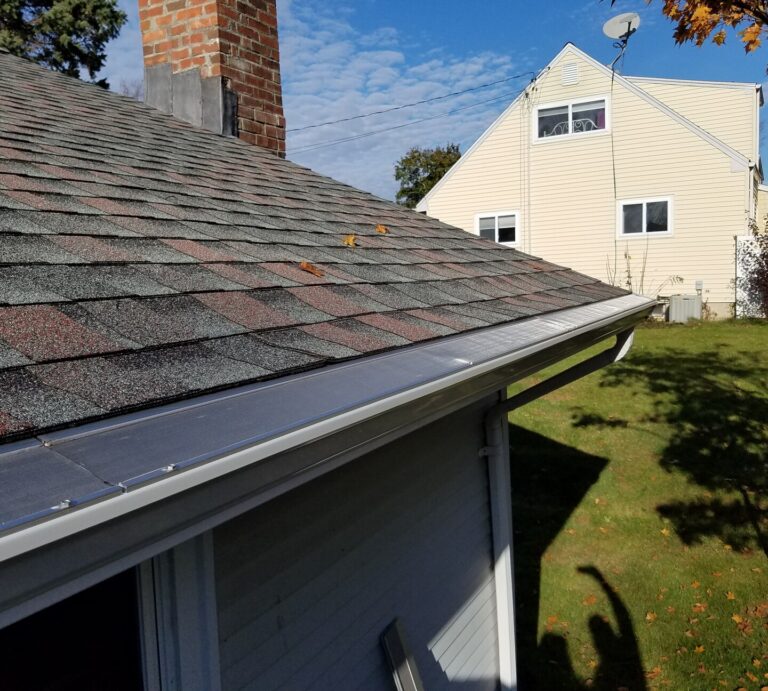
Seamless aluminum gutter hung on hidden hangers along a shingle roof
Why gutter pitch matters
A gutter that is dead level, or sags in the middle, holds water. Standing water grows algae, rots the fascia behind it, rusts fasteners and adds weight. In winter it freezes, and ice in the gutter helps ice dams form at the roof edge. A steady slope moves every drop to the downspout so the gutter is empty between storms.
How much slope a gutter needs
The common standard for gutter pitch is 1/4 inch of drop for every 10 feet of gutter. That is enough to move water without making the gutter look crooked against the roofline. Many installers work from sheet metal standards published by SMACNA, the sheet metal contractors’ association.
Length of run
Drop at 1/4 inch per 10 feet
20 feet
1/2 inch
30 feet
3/4 inch
40 feet
1 inch
On runs longer than about 40 feet, the drop gets large enough to show. So instead of one long slope, we set the gutter high in the middle and pitch it down to a downspout at each end. That keeps the line straight to the eye and halves the distance water has to travel.
Hanger spacing for New England
We space hangers about every 24 inches, because wet snow, ice and a gutter guard all add weight.
Near corners and downspouts, where loads concentrate, they go closer.
Every screw should bite into sound fascia, and into rafter tails where possible.
Wider spacing that works in a mild climate is what you see sagging after a heavy New England winter.
Hidden hangers vs spikes and ferrules
Installers used to hang gutters with long spikes driven through a tube, called a ferrule, into the fascia. Spikes work loose as the wood swells and shrinks, and then the gutter starts to pull away. Hidden hangers clip inside the front lip of the gutter and take screws, so they hold far better and stay out of sight from the ground. We use hidden hangers on every seamless gutter we install.
How to check your own gutters
After a rain, look for water still standing in the gutter an hour later.
Run a hose at the far end of a run and watch whether it all reaches the downspout.
Look along the gutter from the ground for dips, especially between hangers.
Watch for water spilling over the front in the middle of a run, which often means a low spot, not a clog.
Check for gaps between the gutter and the fascia, and for stains or rot on the boards behind it.
Fixing pitch without new gutters
If the gutters themselves are sound, we can often rehang sagging or flat runs on new hidden hangers at the right gutter pitch. Rotted fascia behind them has to come off first, or new hangers will not hold. See soffit and fascia repair. When the gutters are sectional, leaking at the seams, or bent out of shape, replacing them with seamless is usually the better spend. See seamless vs sectional gutters and what seamless gutters cost.
Downspouts and gutter size
Pitch and hangers are half the job. The other half is enough downspouts of the right size, which we cover in 2×3 vs 3×4 downspouts, and the right gutter size for the roof, covered in 5-inch vs 6-inch gutters.
Gutter pitch and hanger questions
How much slope should gutters have?
About 1/4 inch of drop for every 10 feet of gutter, toward the downspout. On runs over about 40 feet, installers usually pitch from the middle down to a downspout at each end.
How far apart should gutter hangers be?
About every 24 inches in New England, and closer near corners and downspouts. Snow, ice and gutter guards add weight that wider spacing cannot carry.
Are hidden hangers better than spikes?
Yes. Hidden hangers are screwed into the fascia and hold far better than spikes and ferrules, which work loose over time and let the gutter pull away.
Can sagging gutters be fixed without replacing them?
Often, yes. If the gutters and fascia are sound, we can rehang them on new hidden hangers at the correct pitch. Rotted fascia has to be repaired first.
Gutters sagging, pulling away or holding water? We can rehang and repitch them, or replace them with seamless gutters on hidden hangers. Written price, no charge.