Which gutter size a New England roof actually needs, and when the bigger gutter is worth it.
The quick answer: on 5-inch vs 6-inch gutters, most homes in Rhode Island, Massachusetts and Connecticut do fine with 5-inch seamless gutters, the standard size on American houses. Step up to 6-inch gutters when a roof is large or steep, or when a valley dumps a lot of water into one corner. Often the bigger fix is a larger downspout. Either way, measure the roof before you pick a size.
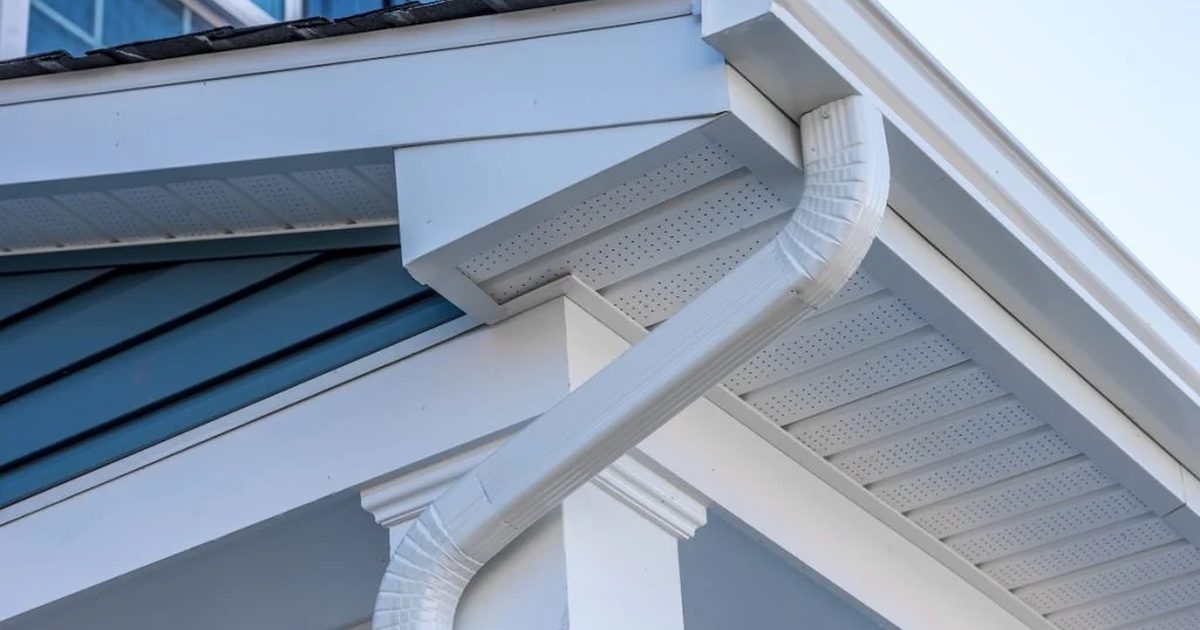
5-inch white seamless K-style gutters on a two-story New England home
What 5-inch and 6-inch actually mean
The number is the width across the top of the gutter. Both sizes come in the K-style profile, the shape that looks like crown molding and is on most houses in the country. The wider 6-inch gutter is also deeper, so it holds and moves noticeably more water.
Size
Typical capacity
Usual downspout
Best for
5-inch K-style
About 1.2 gallons per foot
2×3 or 3×4
Most single-family homes
6-inch K-style
About 2 gallons per foot
3×4
Large or steep roofs, valleys, metal roofs, commercial buildings
Capacity figures are the ones commonly quoted for aluminum K-style gutters. Real-world flow also depends on pitch and on how many downspouts drain the run. Rainfall matters too: NOAA’s precipitation frequency data server shows how hard storms get in your town, and most gutter sizing charts start from that number.
When 5-inch gutters are enough
A typical Colonial, Cape or ranch with ordinary roof planes.
Roof pitch in the normal range, where rain reaches the gutter at a steady pace.
Runs that have a downspout at least every 30 to 40 feet.
No history of water pouring over the front of the gutter in an ordinary storm.
That describes most houses we see across RI, MA and CT, which is why 5-inch is what we recommend most often. It is less metal on the house, it blends in, and it costs a little less per foot.
When it pays to go up to 6-inch
One big roof plane that drains into a single long run.
A steep roof, where water comes off fast enough to overshoot or swamp a 5-inch gutter in a downpour.
Valleys, which pour two roof planes into one spot on the gutter.
Metal roofs, which shed rain and snowmelt much faster than shingles.
Clean, well-pitched 5-inch gutters that still spill over. Size is the likely cause.
A gutter only drains as fast as its downspouts. Many overflow problems come from too few downspouts, or small 2×3 downspouts that clog with leaves and maple seeds. Switching a 5-inch gutter to larger 3×4 downspouts, or adding one more drop, often fixes the problem without changing the gutter size. Our guide to 2×3 vs 3×4 downspouts explains how many you need and where they go.
Does a 6-inch gutter look too big?
On a large two-story home, no. The wider gutter matches the scale of the roof and fascia. On a small Cape or a one-story house with narrow trim, a 6-inch gutter can look heavy, which is one more reason 5-inch stays the standard for most homes. Color matters as much as size: a gutter that matches the trim disappears. See our guide to choosing a gutter color.
What the size difference does to the price
A 6-inch gutter uses more aluminum, so it usually costs a little more per foot than 5-inch, and its larger downspouts add a bit more. Most of a quote is still footage, height and labor. For typical ranges, see seamless gutter cost in RI, MA and CT.
How we size gutters for RI, MA and CT homes
When we quote a job, we look at the size and pitch of each roof plane, where the valleys land, the roofing material, and where water spills over today. Then we recommend a gutter size and downspout layout for each run. Sometimes that means 5-inch on most of the house and 6-inch on one long back run, so we settle 5-inch vs 6-inch gutters one run at a time. We form both sizes on site from heavy .032 aluminum, so every run is one piece from corner to corner. Owner Brad Perry looks at the job himself.
5-inch vs 6-inch gutter questions
Are 5-inch gutters big enough for New England weather?
For most homes, yes. Five-inch K-style gutters handle the rain and snowmelt on a typical house in RI, MA and CT when they are pitched correctly and have enough downspouts. Large, steep or metal roofs are the exceptions.
What is the standard gutter size for a house?
The 5-inch K-style gutter is the standard size on most American homes. Six-inch gutters are the common upgrade for larger roofs and commercial buildings.
Can you put 3x4 downspouts on 5-inch gutters?
Yes. A 5-inch gutter can take a 3×4 downspout, and it is one of the best upgrades for a run that overflows or clogs, because the larger opening drains faster and passes leaves more easily.
Should I switch from 5-inch to 6-inch gutters?
Only if the 5-inch gutters overflow even when they are clean, pitched correctly and have enough downspouts. If they do, 6-inch on the problem runs, or on the whole house, is the fix.
Not sure which size your roof needs? We will measure the roof, look at where water overflows today, and give you a written price for the right size, at no charge.